
(1826 – 1891)
About

Photo: A. O. Bunnell, via Wikimedia Commons
Harriet N. Austin was born in Killingly, Connecticut, on August 31st, 1826, to Joseph Austin Jr. and Abigail Woodward. She was one of 11 children. She moved to Moravia, NY, with her family. After completing her studies locally, she studied medicine at the Water Cure Institution, founded by Dr. Russell Thacker Trall.
Women faced strong opposition to entering the medical profession in the mid-1800s. Women were not permitted to attend medical colleges, and no other schools of “healing” were open to women, putting them at a significant disadvantage.
The Water Cure Institute was the first hydropathic medical college, where students studied all branches of medical practice. They learned to replace drug administration with a new system of water therapeutics. Upon graduation with a medical degree, she became one of the first female physicians in America.
She began her career working with Dr. James Jackson in Dansville, NY, at the Institution, “Our Home on the Hillside.” It became the world’s largest hygienic institute, caring for over 20,000 patients. It was situated on a hillside of 60 acres with spring water flowing from the mountain heights. The institute’s prime focus was the comfort and welfare of the sick, but anyone seeking renewed health or a retreat from the world was offered every opportunity.
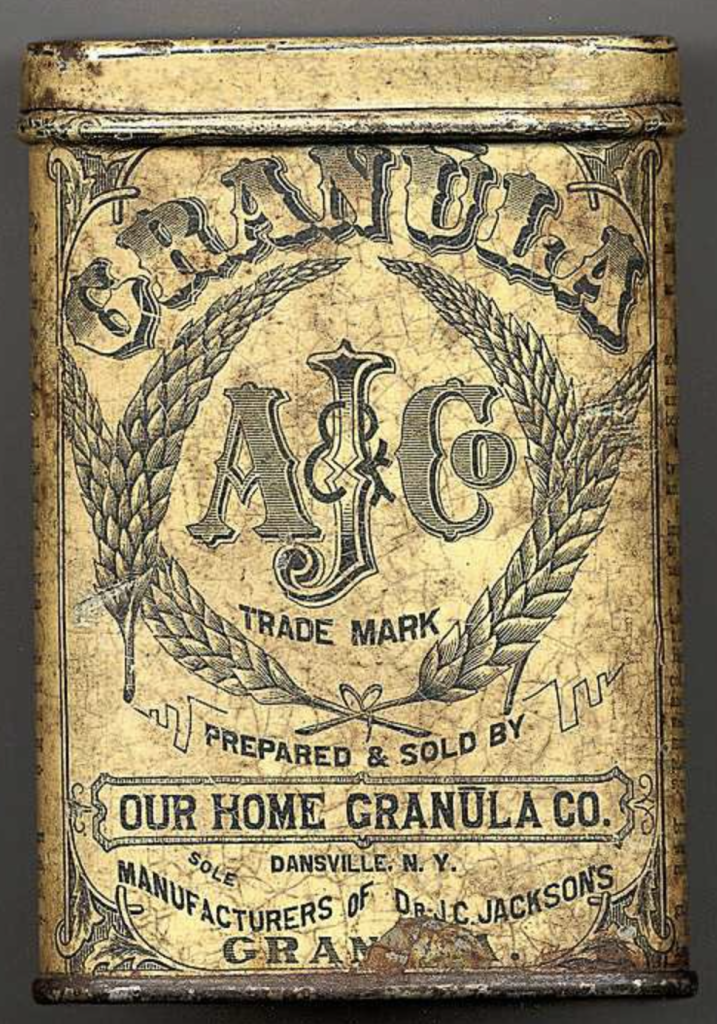
which was served for breakfast.
Photo Credit
She became the adopted daughter and associate of Dr. James C. Jackson and his wife, Lucretia, and worked there throughout her life. In addition to water treatments, patients were served simple but highly nutritious meals. No red meat, sugar, coffee, tea, alcohol, or tobacco were served; instead, the emphasis was on fruits, vegetables, and unprocessed grains. Jackson is credited with the invention of the first cold cereal, a graham-flour-derived recipe he named Granula, which was served for breakfast.
Beyond simple food, the institute promoted clean air and water, sunshine, solid sleep, exercise, and hydropathy treatments as needed. Harriet saw the water cure as the basis for a broader reform movement to expand women’s societal role and improve their health through hydropathy and dress reform.
As a dress reform supporter, she invented the “American Costume.” Clients at the clinic wore this style of dress because it was less restrictive and promoted health. It featured a corset-less mid-length dress or skirt worn over trousers. She designed and made copies of this pattern for women to wear at home. Although practical, this dress style never became very popular. Uninfluenced by others’ opinions, Harriet continued to wear this style of clothing until her death.
Clara Barton came to the clinic in 1876 and recuperated under Dr. Austin’s care. Years of nonstop travel as the founder of the Red Cross had taken a toll on her health. Making a remarkable recovery, Clara remained in Dansville for ten years. In 1881, she began the first local chapter of the Red Cross. During this time, Harriet and Clara became close friends. Clara was so impressed by Harriet’s medical work that she wrote a tribute to her qualities and professional abilities as a physician.
In 1882, the institute suffered a fire. At this time, Harriet decided to retire. She didn’t have the heart to rebuild, so she sold her interest to her brother, Dr. James H. Jackson. However, she continued to write for the “Laws of Life and Journal of Health,” a magazine she had edited for many years. Leaving behind an incredible legacy, she greatly influenced medical and dress reform.
Dr. Austin died in North Adams, Massachusetts, in 1891 and was buried in the Jackson lot in Greenmount Cemetery.
Dr. Harriet N. Austin was one of the few prominent female hygiene doctors. She consistently advocated Dr. James Jackson’s health principles and remained congruent with them throughout her life. Harriet firmly believed that women’s clothing was brutal and physically deformed the female body. She broke with the styles and customs of the day and helped spark a revolution in women’s wear. Walking the streets of Danville in slacks, she was one of the boldest women of her time.
Quote:
— Dr. Harriet N. Austin
A woman’s sphere cannot be elevated until she learns and claims her first great right — the right to health. Then will she seek, by a righteous life, to ensure it, and all the blessings which belong to the possession of a sound mind, in a sound body, will become hers.
Life in the Early 1800
In colonial America, a woman administered most medical care at home. However, by the 1820s, male doctors had displaced women, even in midwifery. Women were no longer trusted to manage their own health, and the old ways of sharing knowledge among women began to wane, especially in urban areas.
Medicine of the 1800s was a gruesome ordeal. Bloodletting, ignorance of germs and infection, the use of mercury pills and laxatives, and “mainstream medicine” were some of the biggest obstacles to good health. Women were not educated about nutrition, health, or their own bodies. Women’s healthcare left much to be desired.

Photo: The Burns Archive, Public domain, via Wikimedia Commons
Medicine was a male monopoly. Medical colleges would not admit female students. Practicing physicians rejected all female applicants seeking an apprenticeship. Examining and licensing boards would not license females.
The establishments started by Mary and Thomas Nichols and Russell Thacker Trall admitted female students and graduated women with the degree of Doctor of Medicine. These female doctors were eagerly received and made excellent names for themselves.
However, as the population moved into unsettled areas of the country, particularly in the South and West, a lack of access to physicians contributed to women once again playing a significant role in providing health care. The Popular Health Movement (1830s –1850s) coincides with a resurgence of women as health practitioners.
Impact of Clothing

Photo: Envato
Women wore dresses with large, voluminous skirts. Layers of petticoats were used to create this large skirt. These layers were then replaced with the crinoline. The crinoline was an undergarment of steel hoops that created a cage for skirts to sit on.
In the 1850s, women commonly wore two-piece dresses (a separate bodice and skirt). The weight of the skirts made fast walking taxing and cumbersome. Working alongside an open hearth became a health hazard, as long skirts easily caught fire.
Corsets tightened the waist, squeezed the chest, and made breathing shallow. By the 1830s, steel replaced whalebone, making the corset significantly tighter. This action forced the ribs closer together and narrowed the entire rib cage. Internal organs shifted to accommodate the new shape. The heart was pushed into the chest cavity, and the intestines were forced downward. Rib compression prevented the lungs from fully expanding. This resulted in shortness of breath, fatigue, and, at times, a loss of consciousness. For this reason, women needed a carry smelling salts.

She designed and made copies of
this pattern so women could take it
home and add it to their wardrobes.
Photo: Dept. of Archives and Special Collections,
Loma Linda University
Corsets also negatively impacted the organs below the ribcage, deformed the ribs into an “S” shape, and misaligned the vertebral spines. For these reasons, Dr. Austin discarded typical female attire and wore pants. That was daring in those days, but being a Hygienist took daring, too.
Harriet was an adamant proponent of dress reform, as the day’s fashions were not designed to be healthy. Women who came to the institute needed a less restrictive mode of dress that would promote health. In response, Harriet created an outfit known as the “American Costume.” It featured a mid-length dress or skirt worn over trousers and did not utilize a corset. She designed and made copies of this pattern so women could create a healthy wardrobe at home.
Many opposed this dress style as being too similar to men’s clothing. Harriet wasn’t too concerned about others’ opinions, and while traveling and lecturing on clothing reform, she continued to wear her designs. She wore this style of clothing all her life.
Teachings
Quote:
“Men, women, and children eat, drink, work, sleep, and dress in modes that defy all nature. When the system yields to their daily outrages, instead of checking themselves to see what may be done to remove ill health, they immediately place themselves in the hands of those who will professionally do their thinking and take over their health care. Hundreds of years of practice have shown the fallacy of this arrangement.”
–HARRIET AUSTIN, M.D.(1826-1891)
During this time, medical treatment in America seems incomprehensible by today’s standards. Physicians frequently bled patients to “force the disease out,” and many died in the process. Blistering was also a widespread healing technique. Houses were unventilated and foul-smelling. Sanitation was neglected; tobacco was used almost universally, and disease was rampant. Water was routinely withheld from the sick, heightening the chances of dying from dehydration. More often than not, the ‘cures’ were worse than the diseases!
Harriet Austin recounts a case of this kind. A person she knew lay in a hotel among strangers, where he was expected to die. “He was tormented with thirst day and night and could not obtain a drop of water. To aggravate his suffering, he constantly heard a running stream of water at the corner of the building. He watched for an opportunity and crawled out of bed, down the stairs, and around the house until he found a large watering trough where water was falling. Into this, he managed to get, and there he lay and drank all he wanted. The panic was terrible when he was discovered. He was placed in bed, clothes heaped upon him, and a messenger sent in haste to bring the doctor to see him die. Before he arrived, however, he was sleeping sweetly, and from that moment, he recovered.”
In addition to being deprived of water, patients were denied fresh air. Physicians issued firm instructions to keep the room and windows closed, and they often opened and closed doors swiftly. No fresh air was permitted, even if the room was sweltering or the patient suffered from a high fever. Patients were made to struggle in the confined atmosphere of their sick, putrid chamber. It would be impossible to estimate how many deaths this lack of fresh air caused.
Notable Achievements
Medical colleges would not admit female students, so men held a monopoly on medical practice. Harriet Austin’s attendance and graduation from medical school, and her becoming one of the first women to be awarded a medical license in the country, were a significant achievement.
Dr. Austin heavily supported the Dress Reform Movement and wrote “The American Costume, or Women’s Right to Good Health.” Her father, James Jackson, founded the National Dress Reform Association, which she supported and helped organize. Austin reveals how water-curists included dress reform among a list of other lifestyle reforms which would improve women’s health and, possibly, women’s social position.
Harriet created an outfit that became known as the “American Costume.” It featured a mid-length skirt worn over trousers and did not utilize a corset. She designed and made copies of the pattern so women could take it home and add it to their wardrobes. Though very practical, it never gained wide popularity.

A Family Health Journal
Harriet edited and wrote for The Laws of Life, A Family Health Journal, for the rest of her life. She focused on all subjects related to life and health and summarized the knowledge gained by America’s largest Hygienic Institution. The aim was to advocate a healthy lifestyle and to teach how to live, grow, and develop. It included articles on health and social change, especially women’s clothing reform.
Ever the educator, she wrote Baths and How to Take Them. In this publication, Dr. Austin describes how baths are used as a treatment. She concludes the book by discussing preparation and various bathing treatments.
She also authored Dr. Harriet N. Austin’s New Method of Treatment of Female Diseases. This book summarizes what she observed, learned, and practiced, focusing explicitly on women. Harriet was a talented physician, author, editor, and advocate for women’s clothing reform. Her writings left behind a significant legacy and helped influence medical reform.
Learn more from: (Read direct excerpts)
- Trop, Jack. (1961). You Don’t Have to Be Sick. New York: Julian Press.
- Shelton, H. (1968). Health for the Millions. Youngstown, OH. National Health Association.
- Lennon, J., Taylor, S. (1996). The Natural Hygiene Handbook. National Health Association, Youngstown, OH.
- Shelton, H. (1934). The Science and Fine Art of Natural Hygiene – The Hygienic System: Volume I. National Health Association, Youngstown, OH.
- Graham, S., Trall. R., Shelton, H. (2009). The Greatest Health Discovery. Youngstown, OH. National Health Association.
- Shelton, H. (1968). Natural Hygiene: The Pristine Way of Life. Youngstown, OH. National Health Association.
The NHA wishes to remind the readers that nothing in this or other publications is intended to constitute medical treatment or advice. Readers should further be aware that in several areas, previous publications do not reflect the NHA’s current teachings or health approaches.
Our Mission
The National Health Association’s mission is to educate and empower individuals to understand that health results from healthy living. We recognize the integration of all aspects of health: personal, environmental, and social. We communicate the benefits of a plant-based diet, exercise and rest, a healthy environment, psychological well-being, and, when indicated, fasting.

 SUBSCRIBE TODAY AND NEVER MISS AN UPDATE

